
Paste an essay for an instant, evidence-based score, then the exact fixes to move your kid's writing toward Band 5–6.
Built around NSW Selective and ACER Scholarship marking criteria.
✍️ Paste your kid's essay
Built by a Sydney parent (and data analyst) · tested against human-marked essays and the official NSW samples →
Know the score, and exactly what to fix to reach Band 5–6.
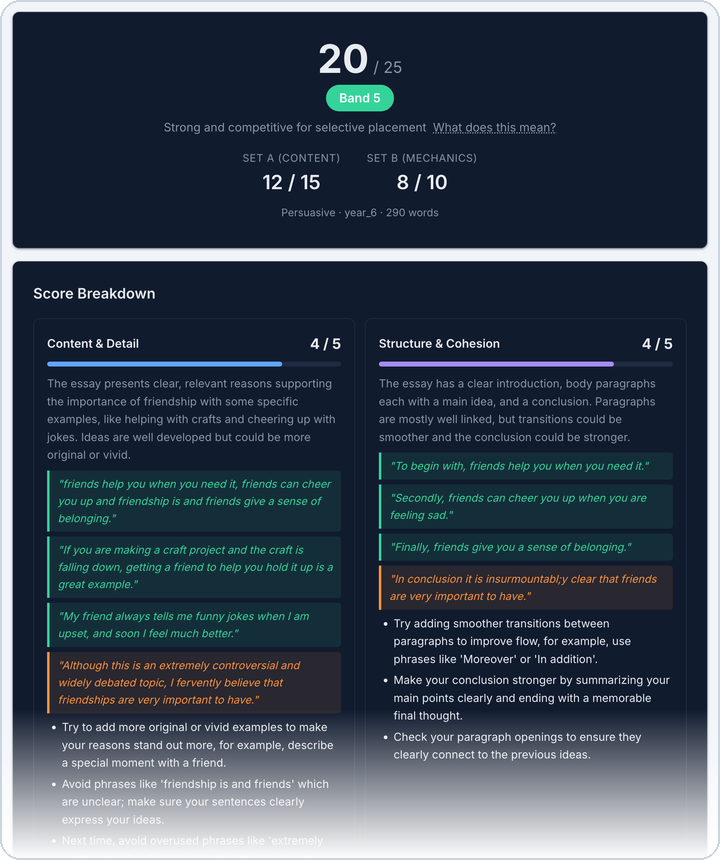
The essay presents well-chosen content with relevant and clear examples supporting the importance of friendship, such as helping with crafts and cheering up when sad. Ideas are well developed but could be more vivid or original.
This is a typical Band 5 response
Polish the flagged spelling and transitions, and this same essay reaches about 22/25 (Band 6).
Every dimension is scored like this. The live tool breaks down all 6, each with quotes from the essay and specific fixes.
“The park was very fun. I played games and it was really good. I liked it a lot and I want to go there again because it made me happy.”
“The park was full of laughter as I raced across the field with my friends, enjoying every moment. By the end of the day, I left with a big smile, already hoping to return for another exciting adventure.”
Most marking tools stop at a number. EurekaWrite turns each weakness into a small, do-it-now fix, so your kid actually improves, one sentence at a time.
After scoring the essay above, your kid gets fix-it cards like these. One small change at a time is far easier than rewriting the whole essay, and they can still choose a full rewrite if they prefer.
Essays are scored across 6 dimensions, matching the NSW Selective School writing criteria (Set A + Set B, total 25 marks). Learn what each score means →
| Dimension | Max | What it measures |
|---|---|---|
| Content & Detail | 5 | Relevance, specificity, development, originality |
| Structure & Cohesion | 5 | Paragraphing, sequencing, cohesion, satisfying ending |
| Style, Vocabulary & Register | 5 | Word choice, stylistic features, tone, formality |
| Sentence Variety & Control | 4 | Length/type variety, complex sentence control |
| Punctuation | 3 | Correctness, range, deliberate use of internal punctuation |
| Spelling | 3 | Common, irregular, and ambitious word accuracy |
Every version of the scorer is tested against 42 human-marked essays before it goes live, and we publish the numbers. See how accurate EurekaWrite is →
Every essay comes back scored on all six dimensions, each with a short rationale and quotes pulled straight from your child's writing. This is the actual screen, not a mockup.
| Band | Score Range | Interpretation |
|---|---|---|
| Band 6 | 22–25 | Outstanding, top-tier selective school level |
| Band 5 | 18–21 | Strong, competitive for selective placement |
| Band 4 | 14–17 | Competent, solid skills, room to sharpen |
| Band 3 | 10–13 | Developing, key areas to work on |
| Band 2 | 6–9 | Emerging, needs focused practice |
| Band 1 | 0–5 | Beginning, building foundational skills |
Timed writing practice, just like the real NSW Selective test. Read our genre guides: Narrative, Persuasive, Informative.
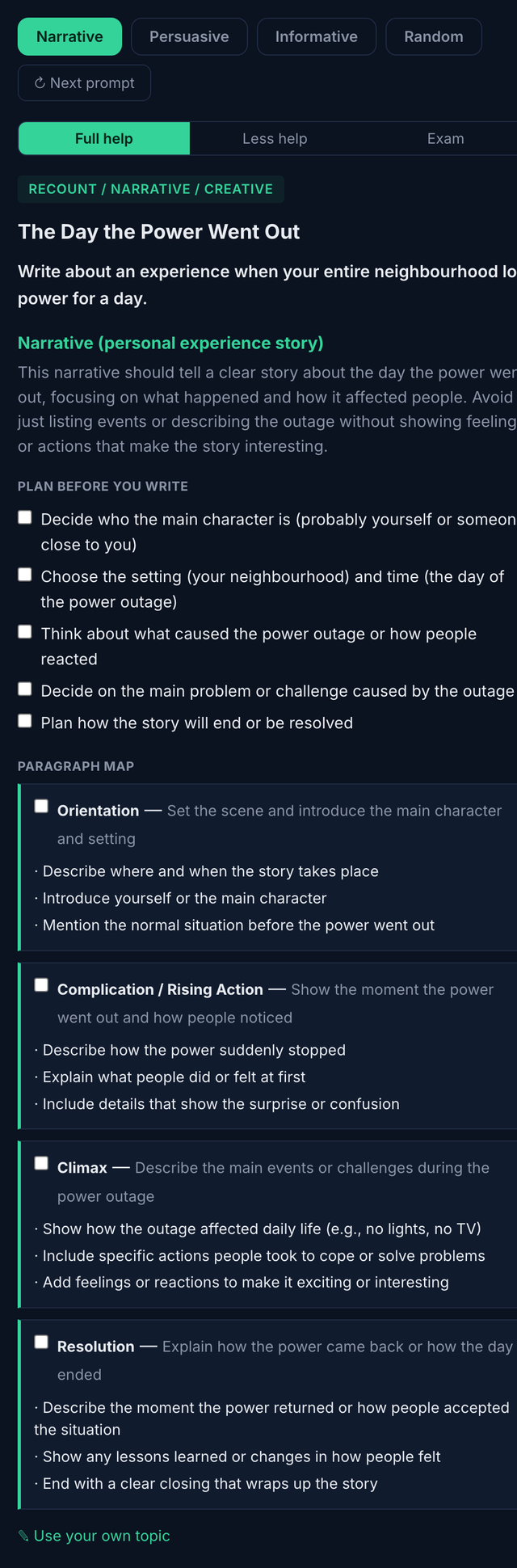
Open the writing workspace and your child gets a paragraph-by-paragraph plan for the piece. Start with the full scaffold, then switch to less help, then exam mode, as their writing gets stronger.
50 original practice prompts across every genre, each with three quick tips, plus a one-page marking guide and a real scored example. Free, and it downloads straight away.
One or two parent-to-parent emails, occasionally. Unsubscribe in one click.
Your download is ready.
Download the 50 prompts (PDF) ↓
Thanks, you're on the list. We also sent a welcome email to your inbox.
Get dimension-by-dimension scores with specific evidence from your child's writing, in under 30 seconds.
Scoring criteria match the real Selective High School Placement Test, Set A (content, structure, style) and Set B (sentences, punctuation, spelling).
5 min plan + 22 min write + 3 min proofread, just like the actual NSW test. Helps your child learn the exam rhythm, not just the writing. Try a timed prompt.
Submit essays regularly and watch scores improve. See which dimensions are growing and which need more practice.
No real names required, students use nicknames only. Essays are used only for scoring, and under our AI provider's current API terms are not used to train their models. See our Privacy Policy.
The NSW Selective Writing Test is scored out of 25 marks across 6 dimensions in two sets. Set A (15 marks) covers Content & Detail (0–5), Structure & Cohesion (0–5), and Style, Vocabulary & Register (0–5). Set B (10 marks) covers Sentence Variety & Control (0–4), Punctuation (0–3), and Spelling (0–3). Total scores are mapped to Bands 1–6.
The test may ask for one of three genres: Narrative (storytelling with plot, character, and setting), Persuasive (argument with evidence and rhetorical devices), or Informative/Discursive (explanation, report, advice sheet, or discussion). Students should prepare for all three as the genre is unknown until test day.
Effective preparation involves regular timed practice (30 minutes per essay, matching test conditions), structured feedback on each attempt, reading widely to build vocabulary, and tracking progress over time. A 12-week plan with 1–2 essays per week is a proven approach. See our complete preparation guide for a detailed week-by-week plan.
Band 5 (18–21 out of 25) is generally competitive for selective school placement. Band 6 (22–25) is outstanding. Band 4 (14–17) may be sufficient for less competitive placements, especially with strong scores in other test components. There is no fixed passing score, it depends on the cohort and the specific school.
EurekaWrite's AI scorer is designed around the NSW Selective Writing rubric and scores essays across all 6 official dimensions. Every score is backed by specific evidence quotes from the student's writing, making feedback transparent and verifiable. It is a study aid, not an official assessment, no AI can replace a human marker. We also test every version of the scorer against 42 human-marked essays, including the publicly released NSW sample responses, and publish the results on our accuracy page.
Yes. The 6-dimension rubric EurekaWrite uses overlaps strongly with ACER's 4 marking criteria (Ideas, Structure, Vocabulary, Grammar & Spelling). The same writing skills that score well in NSW Selective also score well in ACER scholarship papers. EurekaWrite is a useful preparation aid for both, though it is not an official ACER scoring tool. See our Scholarship vs Selective Writing comparison for how the two tests compare and how preparation transfers.
In-depth resources to help your child understand the test and improve their writing.
Scoring system, genres, band meanings, and a 12-week preparation plan.
Bad-vs-good examples for the most common errors, with specific fixes.
6 practical strategies for timed practice, feedback, and focused improvement.
Real examples with full score breakdowns and marker commentary.
An occasional email with sample essays, marker patterns, and Selective + Scholarship prep, written for parents.
No spam. Unsubscribe in one click.
Paste your kid's essay and get their first score free.
Score My Kid's Writing